Showing posts with label Japanese. Show all posts

20 Apr 2013

What language fits your personality?

Language is communication. Communication in different parts evolved to be more beneficial for those who speak it. These changes gave the language a 'personality'. Lets find out what language suits your personality. This is my expression of these languages. 

Creative Common by Enric Archivell
Spanish:
An easy to spell and pronounce language which has a Latin American exoticness. If it was a food it would be spicy without too much to burn on your tongue. It can be helpful with business, if you live in the Americas. It can be seen as a travellers language as it is the second most spoken language after Chinese. 


Creative Common by Doug
Creative Common by Fingle

22 Dec 2012

How to make custom home-made T-shirts for Christmas

This year I wanted to give my friends Christmas gifts that fitted under three requirements:

- Homemade
- Personal 
- Useful

Custom T-shirts fit under all three requirements (kind of: the t-shirts are bought). 

This is how to make one: 

You will need - 
 - a T-Shirt
Gem Stone glue
- A pencil
- Paper
Dye + ingredients needed on the packet (normally salt is also also needed)
- A Bin Lid
- Most importantly, creativity

Instructions:
Step 1 - Design
It is ideal that you draw in pencil what you are going to draw in glue
Step 2 - Soak T-Shirt in water
Squeeze out any excess water in T-Shirt
Step 3 - Put wet T-Shirt on a flat bin lid
Step 4 - Drawing
Draw / Write design using a washable glue before T-shirt dries completely.


Step 5 - Drying
Dry T-Shirts in the Sun until the glue is clear or more than 80% is clear.


Step 6 - Dying
Dye T-Shirt according to the instructions on the packet.
You may also want to tie-dye the back of the T-Shirt.
When T-Shirt is desired colour, wash in soapy water until no excess dye comes out.

Step 7 - Dry (again)
Dry T-Shirt after washing.
The T-Shirt above is for one of my friends who loves Japanese culture.
The tie-dye looks great on the back of the T-shirt


Quotes or verses from the Bible look good on T-Shirts.


Step 8 - Wrapping
Give present to your friend or family member and see the smile on their face. :)
Wishing you a Merry Christmas, I hope you like the T-Shirts I designed.
Write your thoughts in the comment section.

2 Dec 2012

Japan Culture and Art Festival 2012

Last Sunday (25th of November), I went to Japan... well not really Japan but kind of a half way illusion. 
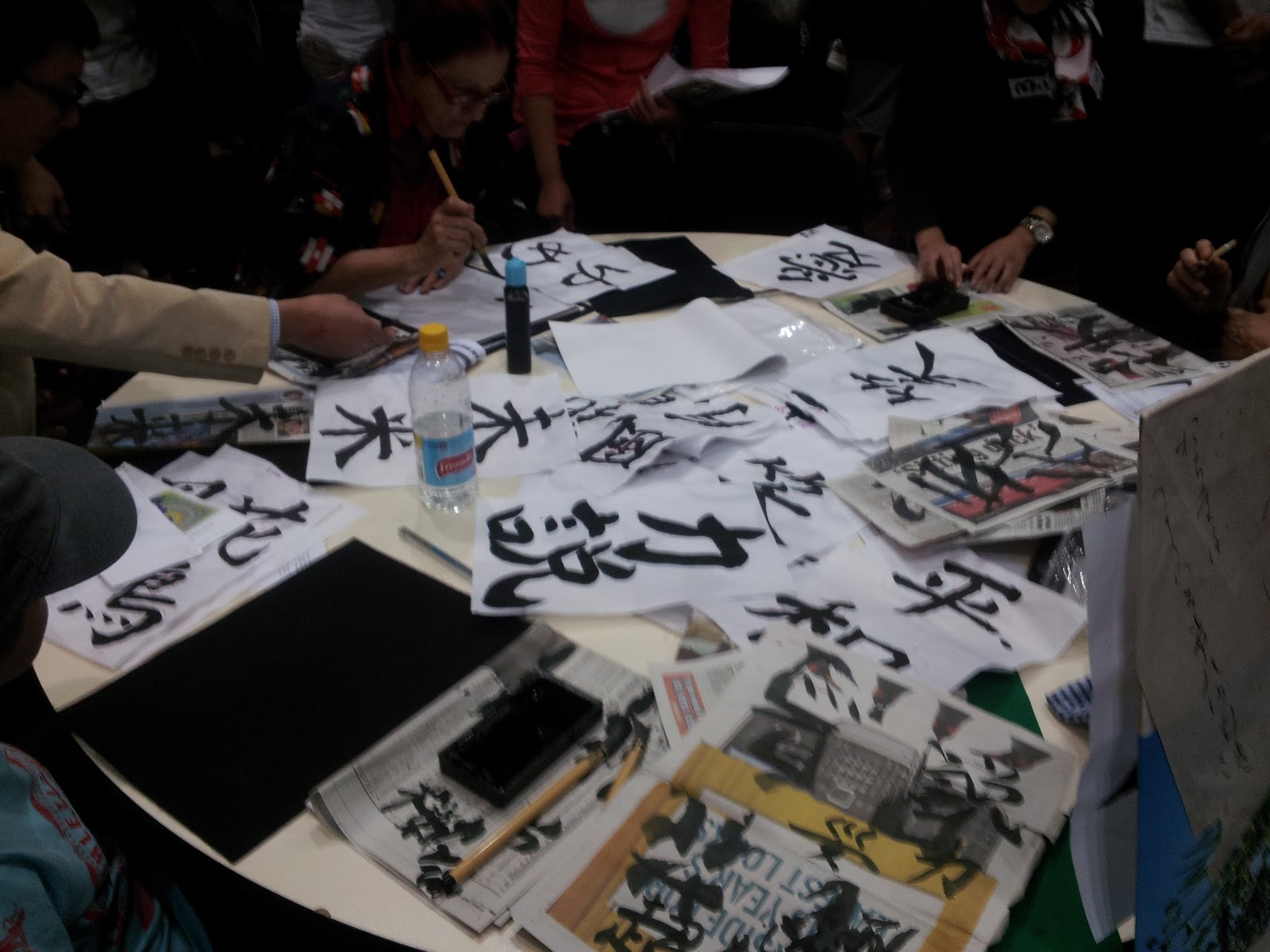
I went to the Japan Culture and Art Festival, which displayed traditional and modern Japanese art forms and culture. There was origami, calligraphy, traditional dance, modern music, martial arts and traditional games and lots of Japanese people.

This was my experience there:


Entrance 
Origami - I learnt to make an origami flower
Martial Arts
Kendama (Japanese toy)
Traditional dance
Japanese calligraphy
I learnt how hard it is to do Japanese calligraphy (my name in Japanese).
Left - Neat, nice done by an expert, Right - My attempt
 
Ikebana - Flower arrangement
Japanese game - go 
Score -
Opponent = 9 points
Me = -13 points
You know you failed when your score is in negative numbers.
 
Pastel Art

Japanese rice ball thing with green soy (very chewy)
Kirigami Lotus (Origami with cuttings) 
Kirigami dragonfly 
Kirigami bears 
A gaijin (non-Japanese) in a sumo suit
The Japan Culture and Art Festival was fun as well as being a bit too loud. I learnt new things about Japan and Japanese culture which I didn't know. I went to many other stalls and places but couldn't take photos due to the large amount of people pushing and shoving to look at what is on the table. :) 

Overall, I enjoyed the day and got to experience Japanese culture that I would have had to fly to Japan to see or research on the internet. 

Links: 
Japan Culture and Art Festival website
Japan Culture and Art Festival Blog

20 Jul 2012

What languages are harder to learn - Photo Blog

Source: http://zidbits.com/2011/04/what-is-the-hardest-language-to-learn/

I believe the table is missing German and Indonesian / Malay. If I was going to add them, I would have German in the bottom of the easy list or at the top of the medium list. I would have also put Indonesian in Medium only because of the diverse vocabulary (Indonesian has a lot of loanwords from Malay, English, Dutch, Spanish, Chinese languages, Portuguese, Sanskrit and Arabic). Indonesian grammar is simpler than Spanish and other Romance languages, the sentence structure is logical and there is no tense. Also questions can be made out of sentences very easily. E.g. Saya tinggal di... (I live in...), Anda tinggal di mana? / Di mana anda tinggal? (Where do you live?).

I agree with 80% of the table but the only fact I disagree with is that it takes 88 weeks to learn Chinese, Korean, Japanese or Arabic because Benny Lewis learnt to speak relatively fluent Mandarin in 3 months.  
What do you think of this picture? Please write your thoughts in the comment section below.

22 Apr 2012

How to impress many, increase iq and meet and speak to more people?

Do you want to impress many, increase your iq or speak to more people?

If you answered yes to any of these questions, I believe learning another language or a word in a couple can help you. When you start a conversation the first word you would say is hello (to an unfamiliar person) or hi (to someone familiar). So the word for hello or hi or 'how are you?' would be good word to know in another language. 

Key:
(r) = rolled r
(rh) = guttural r
˜ = nasal sound

How to say hello in common languages:


#1 Mandarin Chinese你好 (ni2 hao3) (pronounced 'knee' with a high rising tone and 'how' with a high falling then rising tone) 

#2 Spanish: Hola (pronounced o-la)
#3 English: (I hope you would know that already)
#4 Hindi: Namaste (pronounced na-mahs-tay) or Namaskar (pronounced na-mahs-ka(r) )
#5 Arabic: مرحبا (pronounced ma(rh)-ha-ba) or السلام عليكم (pronounced al-sa-laahm a-lay-koom) meaning 'peace be with you' or 'peace upon you'


#6 Bengali: Nomaashkaar (pronounced no-maahsh-shkaah(r) (Hindu) or Asalaam Alaykum (Muslim) 
#7 Portuguese: Olá (European) or Oi (Brazilian)
#8 Russianпривет (pronounced p(r)ee-vet) or Здравствуйте (pronounced zd(r)ahv-stvoo-ee-teh)
#9 Japaneseこんにちは (kon'nichiwa) (pronounced kon-nee-chee-wa)
German: Hallo
Vietnamese: Xin Cháo (pronounced shin chow or sin chow depending on the dialect) 
French: Bonjour (pronounced bãn-zho(rh) )
Korean안녕하세요 (pronounced ahn-nyeong-ha-se-yo 
or ahn-yông-ha-se-yo)
Cantonese你好 (pronounced lei with a high rising tone and hou with a high rising tone or nei with a high rising tone and hou with a high rising tone)
Turkish: Merhaba (pronounced ma(r)haba
Italian: Ciao (pronounced chow)
Polishcześć (pronounced cheshch) 
Indonesian: Selamat (pronounced se-lah-maht):  Pagi (pronounced pah-ghee) (in the morning), Siang (pronounced see-ung) (in the early afternoon), Sore (pronounced so-(r)ay) (in the late afternoon) or Malam (pronounced mah-lahm) (at night) or Halo
Thaiสวัสดี (pronounced sa-wa-dee)
Tagalog: Kamusta (pronounced ka-moos-tah) or Halo
RomanianBună Ziua (pronounced boo-nuh zee-wah)
Dutch: Hallo
Khmer: Sok subai tei? (how are you?) (pronounced sock soo-bye tay)
Greekγειά σου (pronounced geia sou)
Catalan: Hola (pronounced like Spanish)
Czech: Ahoj (pronounced a-hoy)
Swedish: Hallå (pronounced ha-looh)
Hebrewשלום (pronounced shah-lom)
Finnish: Hei (pronounced hay)
Afrikaans: Hallo
Norwegian: Hallo

... and one more -

Esperanto: Saluton (pronounced sah-loo-ton)


Pop quiz:
1. What is significant about the first nine languages on the list? 
2. Why is Dutch before Norwegian and Vietnamese before Italian?

Please write your answers in the comment section below. Answers revealed next post.